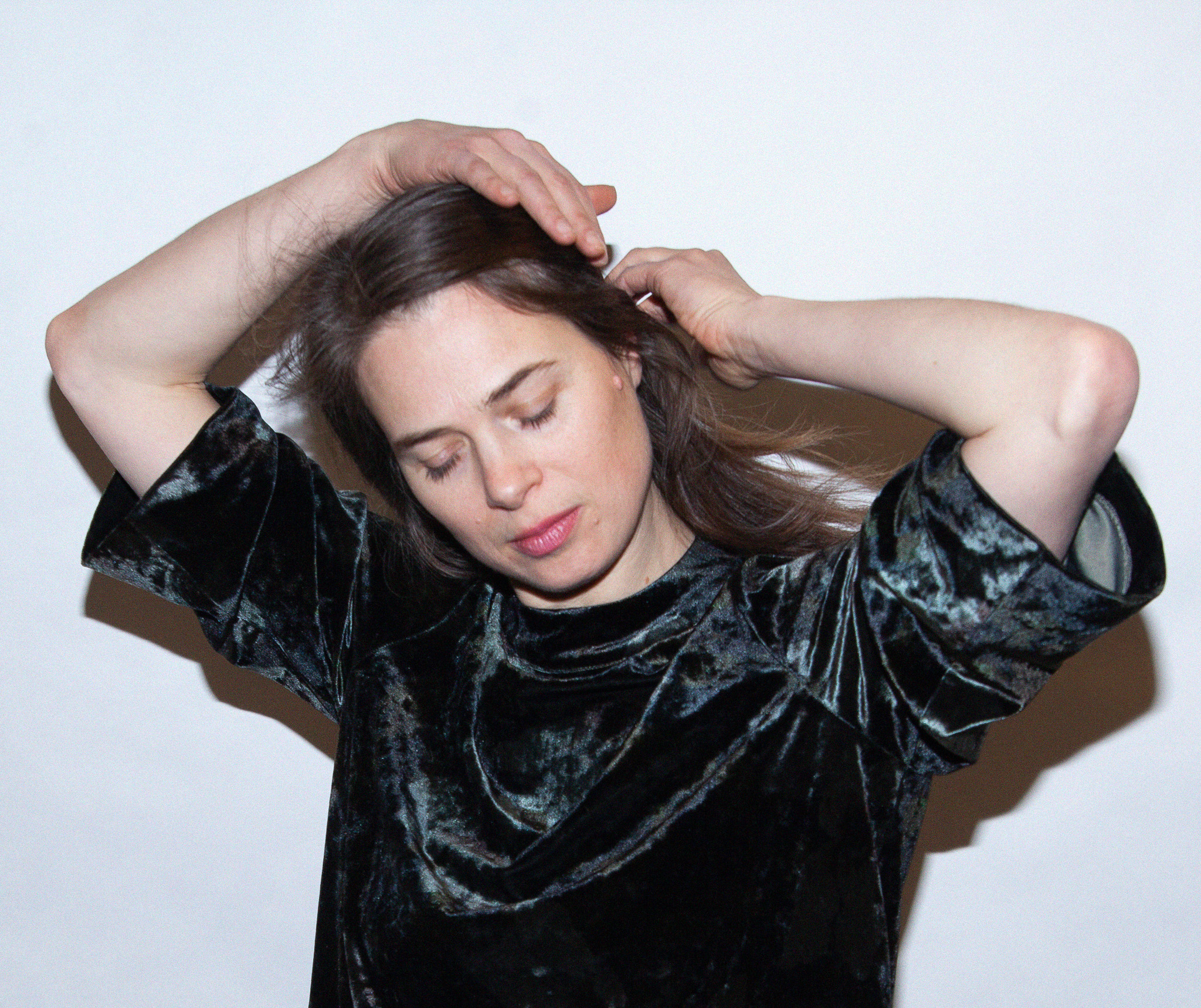
Every month someone, often from the company, writes a letter to another person who then picks up the pen and writes to someone else. The letters are often personal and reflect on dance, the wonders and challenges of dance and what it’s like to perform it.
The letter below is written by the dancer Eleanor Campbell to Luca Seixas, who is also a dancer.
Subscribe to our newsletter to get the letters directly to your inbox every month.
Dear Luca,
I received a letter from Mia that has inspired many nice thoughts. Thank you for being my captive listener – and bearing with me – as I unravel them. Mia invited me to reflect on my experience of being an audience member in dance performances and how this influences my own practices. She wondered, how do I absorb impressions? What do I take with me? Do I steal (movements, gestures, or something else entirely)?
I will start by saying that watching dance (which uses more senses than just the visual) has been an essential part of my dance learning. As a young eager dancer, I would watch my teacher demonstrate a tondu and attempt to absorb all details. How her foot stroked the floor like a match. Where in her body moved a lot relative to what moved less. What was her inner musicality? At times, I would simplify, imagining her as a simple line drawing. Or invert, focusing only on the (moving) space around her. I watched. I tried. I watched and tried a split second later, as if to catch the movement. I looked sideways, bottom to top. I blurred my eyes. I closed my eyes. I felt. I layered my self-image on top of her image, so in my imagination, we did the movement in tandem. Feeling the feeling that I imagine I would feel, if I did the same movement.
These kinds of experiments involving “seeing-feeling”, imagination and kinetic empathy, have continued alongside my dance practice and extended dance in so many directions. I’m wondering now if this sensitivity and interest gave me a huge advantage to become a dancer. Maybe all dancers are exceptional see-feelers.
Luca don’t you agree, that “seeing-feeling” our colleagues is so vital in our work at Cullberg? It shows up again and again, just how much we get by watching each other tackle movement material – especially in moments where we feel stuck in our own habits. We sense each other sensing, weight and gravity, time and space, form and pattern, shifts in mood and tone, and so much more. And you often don’t need to do much analysis for your dancing to be transformed the next time you dive in. Watching opens us new possibilities when words fall short.
And finally, to get to the role of audience member for stage performances – the same holds true. There is of course so much more to take in, a whole artwork to consider, though I usually have bias towards focusing on the performers and how they are to see-feel. I often move a lot in my chair (and apparently make faces which I am not so aware of), finding it hard not to feel ‘moved’. I love it when I sense invisible forces moving through performers and the space. I love it when I’m drawn into a detail, or when time seems to spiral in on itself. It’s not so much the particular movements or gestures that I steal (at least not intentionally). Rather I take away all the imprints of the sensory data unique to each performance, and the admiration of performers in bringing to life far more than we can register in our daily lives.
And now Luca, I’m curious about you. How do you deepen your skills as a performer? It could be interesting to focus on our current creation with Faye Driscoll, which I would say is particularly demanding! I wonder how you guide yourself through the movement material? What are you thinking about? Do you give yourself ‘attention cues’ or use imagery? What about sensations and feelings? I guess I’m curious if you could shed some light on your inner experience, the behind-the-scenes of your fabulous dancing.
Warmly,
Eleanor