Archives: Archived Performances

  • Sonata

    The Belgian choreographer and set designer Stijn Celis has created works for, among others, Ballet Gulbenkian, Bern Ballet, Ballet Mainz, Ballet Wiesbaden, Les Grands Ballets Canadiens and Ballet Nürnberg to name only a few. From 2004 to 2007, he was the artistic director of Bern Ballett, and since 2014 until time of writing has held artistic directorship of the Saarländisches Staatstheater.

    Celis was a frequent collaborator with the Cullberg Ballet. Having previously danced with the company himself, he went on to create UBILOZ Vanilla (1997) Vertigo Maze (2002) and Sore Core (2004). In 2008, he choreographed Sonata, which was danced by Daniel Sjökvist, Patricia Vázquez, Thomas Zamolo and Åsa Lundvik Gustafson at its premiere.

    Johan Inger, artistic director of the Cullberg Ballet at the time, said this about the collaboration with Stijn Celis:

    “Stijn and the Cullberg Ballet have had a continuous collaboration, and it feels exciting to commission a new work from him. Stijn’s movement language is both simple and yet intricate in a way that is idiosyncratic. His work often contains elements of absurdism, and is physically and technically demanding for the performers. Stijn’s choreographic work is unpredictable – unexpected.”

    The work shared a program with Crystal Pite’s Matter of a Maker.

  • Out of Breath

    Out of Breath (2002) was created for Nederlands Dans Theater and set to string music by Félix Lajkó and Jacob ter Veldhuis.

    Out of Breath was danced by six performers, three men and three women, who frenetically seek their place in life. A curvilinear, sloping wall divides the space, which the dancers in turn bisect, circumnavigate or climb over in search of one another or themselves. The costumes and scenography were designed by Mylla Ek, a close collaborator of Johan Inger’s for a number of years.

  • Moderna Museets 50-årsjubileum

    När Moderna Museet i Stockholm fyllde 50 år, hösten 2008, fick Alexander Ekman uppdraget att skapa installationer i museets lokaler på Skeppsholmen. Installationerna, med 40 dansare, från Cullbergbaletten, Svenska balettskolan och Balettakademien, som fyllde flera av museets salar var Cullbergbalettens födelsedagspresent till Moderna Museet.

    Länk till en intervju som SvD:s Anna Ångström gjorde med Alexander inför öppningen.

  • Aluminium

    The term “resistance” was an important point of departure for Mats Ek when creating Aluminium (2005) While not necessarily describing resistance in thepolitical sense, the work took articulated instead an approach to everyday life, to the ability see the familiar with a new lens again and again. To not take anything for granted. Perhaps a question that arises may lead to a necessary change. The structure of the Aluminium follows the architecture of the music, its quiet middle section providing an important contrast and counterpoint. Aluminum had its world premiere with the Compañía Nacional de Danza on the 23rd of April, 2005 at the Teatro Real, Madrid.

    Cullberg performed the piece shortly thereafter in November of the same year.

    Music: John Adams Shaker Loops
    St Luke’s Orchestra
    Publisher: G. Schirmer, INC.
    Nonesuch: 7559-79360-2
    Duration: 26 minutes.

  • Walking Mad

    Walking Mad was created for Nederlands Dans Theater in 2001 to immediate acclaim, wining the Lucas Hoving Production Award for best production, and later the Danza & Danza’s Award (2005).

    Set to Maurice Ravel’s seminal Boléro and the Estonian composer Arvo Pärts Für Alina, Walking Mad charts a dramatic adventure depicting three female protagonists navigating their relationship to themselves and to the men in their lives. A humorous work with grave undertones, it is one of the pieces by Inger that has been performed the most. After its initial creation and subsequent passage to the repertoire of the Cullberg Ballet, it went on to be set on a number of different companies internationally. At the time of writing, it continues to be in demand, some twenty years later.

    Ravel’s Boléro was first created as a ballet. An immediate success upon its opening at the Palais Garnier in Paris in 1928, it featured choreography by Bronislava Nijinska commissioned by Ida Rubinstein. It has gone on to be interpreted by various choreographers including the iconic 1960 production by Maurice Béjart.

    Arvo Pärt’s Für Alina also features in Mats Ek’s Solo for Two.

    Music:
    Maurice Ravel: Boléro (for orchestra 1928)
    Arvo Pärt: For Alina (for piano 1976)

  • Empty House

    Empty House was a reworking of So Now Then (2002) which was originally choreographed for Nederlands Dans Theater.

  • Matter of a Maker

    Matter of a Maker was the Canadian choreographer Crystal Pite’s first work for the Cullberg Ballet. The work shared a program with Stijn Celis’ Sonata.

    This program marked the last for Johan Inger in his tenure as director. Pite, already well known at the time, would go on to become an internationally acclaimed choreographer, making works for major dance companies as well as self produced piece under the company name Kidd Pivot.

    “A monumental work. And the Cullberg Ballet is now, as ever, the ideal instrument for the great choreographers of our time.”
    Sundsvalls Tidning (Sundsvalls Newspaper)

  • Position of Elsewhere

    Position of Elsewhere was Johan Inger’s second full-length work choreographed for the Cullberg Ballet. The piece is divided into three parts that as a whole comprise a kind of survey of Inger’s five years as the company’s artistic director and primary choreographer from 2003-2008.

    “The beginning of the show is very physical in an nearly manic sense. The goal was to conquer or take space with an almost mad, pressing energy. The first part is just about conquering the room. To come and take your place, to work your way in from the sides. In the second part, there is a meeting of sorts that appears. In the third and final part there is a farewell. There it will again be left clean and laid bare,” Inger said about his work before the premiere in the winter of 2009.

    As in Inger’s first full-length work for the Cullberg Ballet Point of Eclipse (2007), he again collaborated with set designer Jens Sethzman and composer Jean-Louis Huhta. Sethzman and Inger felt during the first production that they were interested in taking their collaboration further, to see where it might lead.

    “Johan is heading in a completely new direction, towards a new language” said Jens Sethzman, “and it is an honor to be invited into that process.”

    The set design and lighting have collapsed into a singular sculptural and technically complete apparatus. It both lights the stage and is simultaneously an independent sculptural object.

    “At the same time as Johan develops his large scale work which includes a huge bank of materials and ideas, this sculpture as illumination also carries a solid conceptual framework and can stand on its own as an aesthetic object. I do not know how much our ideas might clash. It is not until we see it built up on stage that we can understand what it means for the entirety of the work,” said Jens Sethzman.

  • Dansarnas egna verk 2010

    In what had become a tradition of sorts the dancers of the Cullberg Ballet presented a varied and rich even of their own work at Moderna Dans Teatern (MDT). Taking place in the spring of 2010, this series of performances marked the third time Moderna Dans Teatern (MDT) had hosted the Cullberg Ballet in this capacity.

    Cullberg Ballet’s dancers Anton Valdbauer, Victoria Roberts, Isaac Spencer and Marylise Tanvet created a solo each. Adam Schütt and Rachel Tess co-choreographed a work, and Joaquim de Santana made a duet for dancers Anton Valdbauer and Sylvie Gehin Karlsson.

    Estas Solo

    Choreography / dancer: Anton Valdbauer
    Music: Clint Mansell, The Last Man, Tree of Life, John Murphy, The Beginning

    Thanks to everyone who made this evening possible. TD department, Nina, Malin, Åsa. To Anna for everything. And specially to Maria Elena for her help, support, understanding and love.

    “Dreaming permits each and every one of us to be quietly and safely insane every night of our lives.”
    William Dement

    Outside the Box

    Choreography / dancer: Victoria Roberts
    Music: The Books, It Never Changes to Stop, 8 Frame, Antonio Vivaldi, Concerto No. 6, in A minor from L’Estro Armonico, op. 3.

    With thanks to Cullberg Ballet for this opportunity, and to James MacGillivray for his love, support and guidance.

    … Every education system on Earth is predicated on the idea of academic ability, and the consequence is that many highly talented, brilliant, creative people think they are not, because the thing they were good at at school was not valued or was actually stigmatized. There is not an education system on the planet that teaches dance every day to children the way we teach them mathematics. I think math is very important, but so is dance. Children dance all the time if they’re allowed to, we all do.… Creativity now is as important in education as literacy, and we should treat it with the same status… By the time they get to be adults most kids have lost that capacity, or rather get educated out of it. We stigmatize mistakes, and we’re now running national education systems where mistakes are the worst thing you can do, and the result is that we are educating people out of their creative capacities… ”
    Abbreviated from Sir Ken Robinson’s TED lecture, 2006, www.ted.com.

    Le Vo (y) age

    Choreography / dancer: Marylise Tanvet
    Music: Trentemøller Moan, Miss You Opto 11.45 p.m.
    My first Solo / Impro project, Work-in-progress.

    “Le Vo (y) age is an interpretation of many emotional pathways. Worn by insoluble questions and tireless doubts. Have I lived in an illusion or was it for real? Will I accept reality? Yes, it is in front of me and I confront it. A common struggle along the same path. “

    Thanks to Anna, Sylvie, Ophélie and my daughter Félicia.

    My Leg is Your Leg

    Improvisation/scenografi/idé: Adam Schütt och Rachel Tess
    Musik: Larkin Grimm, Little Weeper

    Erlkönig

    Koreografi/dansare: Isaac Spencer
    Musik: Hahn Rowe, Yellow Smile

    Who’s riding so late where winds blow wild
    It is the father grasping his child;
    He holds the boy embraced in his arm,
    He clasps him snugly, he keeps him warm.

    «My son, why cover your face in such fear?»
    «You see the elf-king, father? He’s near!
    The king of the elves with crown and train!»
    «My son, the mist is on the plain.»

    ‹Sweet lad, o come and join me, do!
    Such pretty games I will play with you;
    On the shore gay flowers their color unfold,
    My mother has many garments of gold.›

    «My father, my father, and can you not hear
    The promise the elf-king breathes in my ear?»
    «Be calm, stay calm, my child, lie low:
    In withered leaves the night-winds blow.»

    ‹Will you, sweet lad, come along with me?
    My daughters shall care for you tenderly;
    In the night my daughters their revelry keep,
    They’ll rock you and dance you and sing you to sleep.›

    «My father, my father, o can you not trace
    The elf-king›s daughters in that gloomy place?»
    «My son, my son, I see it clear
    How grey the ancient willows appear.»

    ‹I love you, your comeliness charms me, my boy!
    And if you’re not willing, my force I’ll employ.›
    «Now father, now father, he’s seizing my arm.
    Elf-king has done me a cruel harm.»

    The father shudders, his ride is wild,
    In his arms he’s holding the groaning child,
    Reaches the court with toil and dread. –
    The child he held in his arms was dead.

    Adapted from the poem Erlkönig by Johann Wolfgang von Goethe 1782.
    Translation by Edwin Zeydel, 1955.

    Special thanks to Sebastian Gehrke.

    Residual

    Koreografi: Joaquim de Santana
    Musik: Ólafur Arnald, Himininn er að hrynja – En stjönurnar fara þér vel, Thomas Dybdahl, Don’t Lose Yourself
    Dansare: Anton Valdbauer och Sylvie Gehin Karlsson

    A path stayed in the memory
    Stood in front of it and missed what never existed
    In silence the trace of time is frozen it’s the end of
    thinking about thinking.
    The coldness of the known path is no longer felt
    Will you be my light
    I ask you cause you are me and I am you.

  • The Last Bounce

    From the streets to the arena.

    In the spring of 2010, having decided to part ways after thirteen years, the renowned Stockholm based urban dance collective Bounce did so with a grand finale. The performance, held at Stockholm’s Globen Arena, featured nostalgic nods to the past as well as new elements. Bounce invited nearly three hundred dancers from various backgrounds, including the Cullberg Ballet, to participate in five sold out performances. The event was a celebration of the group’s illustrious careers, as well as the various dance styles, expressions, ideas and heritages they called home.

    Among a great many other new ‘Bouncers’ were a number of dance students, the Cullberg Ballet, Harlem Hot Shots swing group, the salsa enthusiasts Caché Dance Company and the German group Spin Kings.The Cullberg Ballet performed an excerpt from Johan Inger’s Position of Elsewhere (2009).

    Bounce members: David Dalmo, Joe Jobe, Filmon Michael, Fredrik Rydman, Ambra Succi, Jennie Widegren and Alvaro Aguilera

  • Point of Eclipse

    Point of Eclipse was Johan Inger’s first full length piece the Cullberg Ballet. The piece marked the first collaboration between Inger and lighting designer Jens Sethzman and composer Jean-Louis Huhta.

    Point of Eclipse was Johan Inger’s first full-length work for the Cullberg Ballet and his first with the lighting designer Jens Sethzman and the composer Jean-Louis Huhta.

  • Hon var svart (She Was Black)

    She Was Black is a semi-abstract surreal adventure in a similar non-narrative spirit as several of Ek’s recent works. The stage design by Peder Freiij is bare and sparse adorned with fragments of decor -The bare stage room, signed by Peder Freiij with fragments of decor – a cut off staircase, a distorted wall – all form a distinctive, singular landscape. A sense of impending settlement or resolution to something is the result. The ballet’s title alludes to a dialogue from a Beppe Wolgers’ revue:

    “I dreamed of God last night.”
    “How did he look?”
    “She was black!”

    Designed by Ellen Ruge, the lighting is restrained and austere, allowing the stage to remain in a half darkness that further enhances its desolate atmosphere.

    She Was Black is accompanied by the Polish composer Henryk Góreckí´s string quartet Quasi una fantasia, dedicated to the black Madonna. The music is in a minor key lending it a tragic sound. This accentuates the overarching mood in Ek’s choreography, a formal explosion of movements and emotions.

    Music:
    Henryk M Górecki: Almost a fantasy
    And the Kronos Quartet

  • Out in context: Marabouparken

    “A visual concert utilizing the body as an instrument.”
    Tilman O’Donnell

    As the name suggests, Out In Context was a performance series initiated by then director of the Cullberg Ballet Anna Grip, attempting to reframe choreographic and performance practices.

    This iteration was choreographed by Tilman O’Donnell. Inspired by the book How To Do Things With Art, by Dorothea von Hantelmann, O’Donnell explored how duration, sound, spatial dissonance, and choreographic harmony might create a new means to see movement.

    Staged in different temporary rooms within the gallery, fragments of a previous exhibition, the performers moved through a repeating score throughout the opening hours of the museum.

    The work featured a guest appearance by a large brown bear.A site-specific work by the Cullberg Ballet at Marabouparken Konsthall

    Konsthall och skulpturpark

    The performance on Marabouparken was shown within the framework of Cullberg Ballet’ s Out In Context.

    Cullberg Ballet’s Out In Context

    Out In Context is Cullberg Ballet’s site-specific project that takes parts of the company’s operations out of its usual context to other spaces than the traditional ones. The choreography is based on the locations unique composition, architecture, history and environment and is created by discovering and examining its hidden meanings. Out In Context seeks to challenge artists and audiences to extend an invitation to share impressions and expressions.

    Concept and Direction: Tilman O’Donnell
    Sound: Tilman O’Donnell
    Video and Light: Thomas Zamolo
    Created by: Alexandra Campbell, Mirko Guido, Hannako Hoshimi-Caines, Andrea Martini, Gesine Moog, Kristina Oom, Csongor Szabó, Jac Carlsson, Tilman O’Donnell
    Live Keyboard: Tilman O’Donnell

  • The Progression of Things

    The Progression of Things

    The Progression of Things (2011) marked the second commission by O’Donnell for the Out in Context series.

    This work was designed for Färgfabriken Museum in Stockholm. The piece was structured in twenty minute performance modules that would repeat and rotate counterclockwise with each iteration. The work was a playful interrogation of time and narrative, composed of a community of those that knew only how to continue in circles.

    “The Progression Of Things challenges broadly conceived notions of history, and it’s requisite conceptions of progress, growth and transcendence through myth building, as a linear phenomenon. While nations, cultures, societies, bodies politic and material are in constant search of myths to live by, largely founded on a linear, forward moving conception of time, what seems to take place is something more like a circular constant. That is to say: we move in what we imagine is a linear fashion, while finding ourselves largely in the same predicaments as human beings, facing existence in a series of identical efforts, redefined by constantly varying sets of circumstances.

    By presenting a performative model of circular constants, my aim is to posit a light alternative to history as linear progression, with it’s necessary critical ocular-centrism, linguistic hegemony, and linear narrative tendencies. Absent this neatly organized progression of time and history, what other kinds of narratives are available to us?

    What is left?”
    Tilman O’Donnell


  • Out in context: Glass Boxes

    Out in context: Glass Boxes

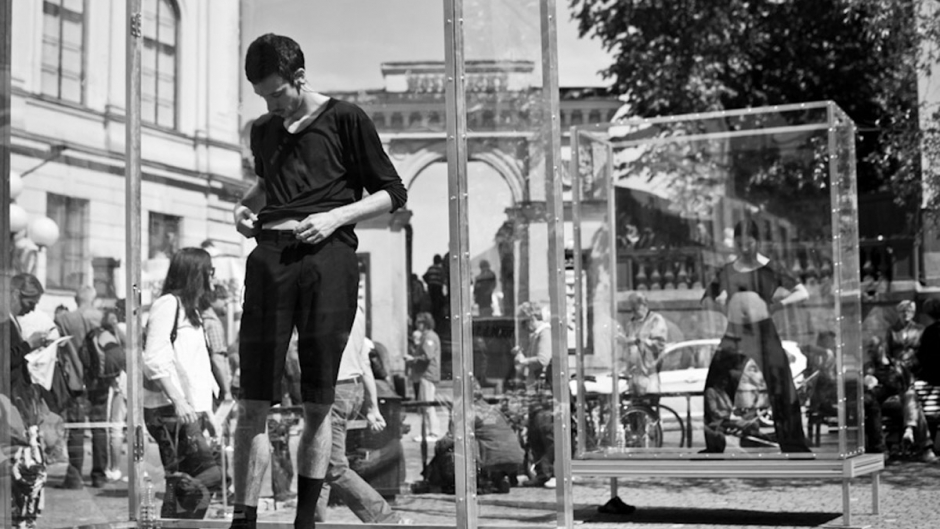
    During Kulturfestivalen in Stockholm 2011, Cullberg Ballet appeared with dance installations by Alexander Ekman, originally created as a gift to Moderna Museet in Stockholm for its 50th bithday. Out in context is Cullberg Ballet’s site specific project that takes parts of the company’s activity out of its usual context to other settings than the traditional.

    The choreography plays with the space’s  unique composition of architecture, history and environment and is created through investigating its hidden meanings. Out in context wants to challenge artists and audiences and reach out to more with an invitation to share impressions and expressions.

  • Inhouse 2011

    As in previous years, MDT (formerly Moderna Dans Teatern) once again provided the forum for the dancers of the Cullberg Ballet to create a varied and rich set of performances. Choreographers included: Alexandra Campbell, Adam Schütt, Andrea Martini, Hanako Hoshimi-Caines, Shumpei Nemoto, Johanna Lindh and Isaac Spencer.

    LIIKE

    Dancer: Alexandra Campbell
    Film: LAJI – Alexandra Campbell, Lisa Holmqvist, Jeanette Steinsland
    Music: Jewels Make U Move
    Duration: 4 minutes

    I multiply on a hill

    Creator / dancer: Andrea MartiniPhoto / video: Yoav Barel
    Music: A Silver Mt. Zion
    Duration: 7 minutes (on repeat)

    Diegese

    Art work: Gesine Moog

    “I started this work at the beginning of February this year not knowing what it would become. Without any aim or time pressure I followed intuitively, step by step, the process, and I immersed myself in observing, listening and following it. From carving, printing, painting, spacing into the passe-partout and finally framing them, it has become the end of October. In this time a series of small pictures, which are able to be seen from all sides, have developed, and the process has fulfilled me with a lot of pleasure and richness of impression. I am very happy and grateful that I can share them with you today and at the same time to close this circle of creation.”

    For men only

    Choreographer: Andrea Martini
    Dancers: Adam Schütt, Mirko Guido, Luis Alberto Rodriguez, Isaac Spencer, Csongor Szabó and Kristóf Várnagy
    Music: Samira Said, Harold Budd, Andrea Martini
    Lighting design: Nette Karlsson
    Make-up: Jessica Krage and Caroline Thörnqvist under the supervision of Olle Johansson.
    Duration: approx 15 minutes

    Ugoku

    Performed by three dancers who usually work in different styles. The piece explores the way to approach movement from different perspectives, researching a common place, with its own style, by the dancers sharing choreographic movement but still retaining their individuality.

    Choreographer: Shumpei Nemoto
    Dancers: Alexander Dam, Markus Bertilsson Almqvist and Shumpei Nemoto
    Music: Alva Noto
    Lighting design: Nette Karlsson
    Duration: 8 minutes

    Nobody’s Serviant

    Total musical expressionism meets total physics. A musical super hybrid made by Örjan Högberg from Fläskkvartetten on electric violin and Johan Skugge from No Science on synth. Together are releasing their first record Nobody’s Serviant. Now they are sneaking up MDT together with Cullberg dancers Johanna Lindh and Isaac Spencer in this dance and music piece Nobody’s Serviant.

    Choreographers and dancers: Johanna Lindh and Isaac Spencer
    Music: Örjan Högberg and Johan Skugge
    Lighting design: Nette Karlsson
    Duration: 10 minutes

    Modal Phenom

    ….the dancers make and listen to sound and are motivated by the enjoyment of hearing, the sensation it produces – the tingling feeling of hearing something you have never heard before, the excitement of a place you have never experienced before. Adam Schütt, 2011

    The ear

    The hair cell that picks up the sound in the ear

    Explanatory pictures

    One hair cells twitching to a beat Modal Phenom playfully explores a complex system of games that involve recognition, denial, call and response, expectation, and the unexpected. Created in collaboration with three dancers, the work builds a movement language and a spontaneous sound score simultaneously, with the incorporation of handmade musical instruments and electronic sound manipulation.

    Concept: Adam Schütt
    Dance and sound: Adam Scühtt, Daniel Sjökvist, Isaac Spencer, Patricia Vázque
    Costume design, instruments and lighting concept: Adam Schütt
    Duration: 25 minutes

    I’ll believe in anything

    Choreographer and dancer: Hanako Hoshimi-Caines
    Guitar intro by Plants and Animals
    Lighting design: Nette Karlsson
    Voice: Rev. Raphael Warnock, pastor of Ebenezer Baptist Church speaking at Troy Davis’ funeral. The state of Georgia shamefully executed Troy Davis on September 21, 2011 despite serious doubts about his guilt.
    Duration: 10 minutes

  • The Way Things Go

    The Way Things Go

    Inspired by the seminal artwork of the same name by Swiss artists Fischl & Weiss, The Way Things Go is a choreographed chain of events, of cause and effect.

    By regarding the body as a combination of express will and mechanical function, the performers continually reshape the circumstances in which they find themselves. Through an interplay between placement within the choreographic line of fire and the willful and precise modes of contact, the performers articulate the fictitious inherent in this inexorable series of events.They collapse, merge, push forward, hold back, stop, slide, pull, balance and fall, blurring the boundaries between activity and passivity. As the performers move through an empty space without a stage or seating, the spectators can follow their movements and be drawn into their choreographic constellations.

    As the patterns and structure of the work change and expand, so too does is the audience afforded the possibility to constellate anew. Now pulling away to avoid a collision, now coming closer so as not to miss a detail, or simply repositioning to see where something new is emerging.

    Premiere 2009
    Performed by Cullberg Ballet at Kulturhuset (2011) as part of the Out in Context series.

    Concept: Jefta van Dinther
    Created by: Naiara Mendioroz Azkarate, Kyung-Sun Baek, Jefta van Dinther, Luís Miguel Félix Norberto Llopis Segarra & Eleanor Bauer

  • Out in context: Malmöfestivalen

    Out in context: Malmöfestivalen

    Cullberg Ballet meets Malmöfestivalen with a brand new site specific piece! In the improvised work, the dancers create the music and the sound design live with microphones, sampled music and their own voices. Cullberg Ballet meets Malmöfestivalen is presented within the frame of Cullberg Out in context, the company’s site specific project that takes parts of the company’s activity out of its usual context to other settings than the traditional.

    Saturday 18 August 2012, at 16:00, 21:00, 22:00.
    Duration: 30 minutes/performance.

  • Out in context: Cullberg Ballet, KammarensembleN and Fotografiska in collaboration

    The Cullberg Ballet, KammarensembleN and Fotografiska collaborate on a new piece, specially composed for Fotografiska (Photography Museum Stockholm). The musicians of the KammarensembleN and the dancers of the Cullberg Ballet created this improvisational work based on mutually devised understandings of structure and texture within dance, music and photography.The piece is organized around five pieces of twentieth century music for soloists instruments. Images by photographer Fanny Oldenburg were projected on the walls of the room, forming landscapes to frame and enhance the movement and music.

    The work is done within the framework of Cullberg Out In Context. Out In Context is Cullberg’s site-specific project that takes parts of the company’s operations out of its usual context to other spaces than the traditional ones. The choreography is based on the locations unique composition, architecture, history and environment and is created by discovering and examining its hidden meanings. Out In Context seeks to challenge artists and audiences to extend an invitation to share impressions and expressions.

    Photographer Fanny Oldenburg

    Fanny Oldenburg lives in Stockholm and was educated at the Nordic Photography School on Biskops Arnö from 2003-2006. She works as a photographer in television, theater and dance, but has a broad portfolio which includes personal portraits and environmental images. The collaboration at Fotografiska will be her first with the Cullberg Ballet.

    About KammarensembleN

    KammarensembleN (KeN) was formed in 1984 in Stockholm and has since its inception been a leading voice in the Swedish new music scene. In collaboration with directors, lighting designers and video artists, KammarensembleN has given a number of acclaimed concerts both at home and abroad. The ensemble has eighteen members. Since 2003, Franck Ollu has been the artistic director.

    About Fotografiska

    Fotografiska’s mission is to show both the well-known photographers and new names. Our aim is to establish Swedish photographic art in the world and international photographic art in Sweden. We offer training, lectures and workshops for both amateurs and professional photographers. We also offer a café, restaurant, a gallery with photos for sale and a shop filled to the brim with photo art. In addition we have concerts, clubs, artist talks and offer the opportunity to arrange events. Fotografiska is for everyone.

    On May 21, 2010 the doors for Fotografiska were opened in the old customs house on Stadsgårdskajen, Stockholm. It did not become an ordinarymuseum, it became an international meeting place for the infinite expression of cultures.

  • Negro con Flores

    Negro con Flores

    Johan Inger’s Negro con Flores (2005) was a sound success on its opening at Dansens Hus. Acclaimed for his surprising light design and subtle choreography, the work heralded the start of a new movement idiom and design language for Inger.

    ”Negro con Flores exists in a landscape between darkness and light, levity and gravity. It progresses through a formation of moods with the goal of breaking loose, moving on. This piece is an attempt to deviate from the path I know and by doing so, hopefully find new beginnings.” – Johan Inger, 2005

    Duration about 35 minutes.
    Music: Stefan Levin
    Premiere danced by: Rei Watanabe, Thomas Zamolo, Alexander Ekman, Tilman O’Donnell, Hlín Diego Hjálmarsdóttir

    Press clippings

    “But it is in Negro con Flores that he surprises us with a new approach. Something of the cocky leaps and lifts of street dancers feature in this work, which swings between tenderness and brutality. ”
    – Expressen 05.11.2006

    “The movements are mixed with an edginess reminiscent of slapstick or cartoons, the dance around a bouquet of roses in particular has comic force and features surprising elements. Inger exploits the Cullberg dancers’ unique combination of technique and drama.”
    – Göteborgs-Posten 06.11.2005

  • xspectacle

    xspectacle

    In November of 2009, the Cullberg Ballet made its debut on the small stage at Dansens Hus, with renowned Canadian choreographers Crystal Pite and Benoît Lachambre. Pite had previously created the full length work Matter of a Maker (2008) for the Cullberg Ballet, and returned to remount the work xspectacle. The piece was originally choreographed for Les Ballet Jazz de Montreal in 2004. The Cullberg Ballet performed it in March of 2010 at Dansens Hus in Stockholm.

    The company went on to perform Xspectacle at the outdoor venue Parkteatern in Vitabergsparken, Stockholm in August of that same year. Later in December the Cullberg Ballet performed xspectacle again at Dansens Hus, this time alongside Ajö, choreographed by Mats Ek for the illustrious dancer Sylvie Guillem.

    Crystal Pite’s notes on xspectacle:

    Xspectacle is a portrait of something familiar and dear to me: dancers at work. The theater is the frame and the audience’s presence affects the images therein: what was once a practical and authentic task is now staged and conscious. From time to time, the performers cultivate their own instability so as to make the dance seem spontaneous. Improvisation, however, guarantees that the unknown gets a voice and that the risks and discoveries inherent therein receive their due attention. So in that capacity

    Xspectacle is simultaneously generated and presented. The set reveals anunadorned simplicity, a utilitarian space punctuated with the elevated (expected even) sense that light and sound afford. Even the dancers’ physicality alternates seamlessly between banal and sublime: they are both simple and spectacular. We see their effort and their skill.

    Returning to xspectacle after almost seven years has been both a conflicted experience but also clarifying. It reminds me of what I love about dance: that it is a fleeting and adaptable art form always in a state of creation. Xspectacle continues to be shaped and changed by each dancer who moves through it, both past and present. I want to thank the Cullberg Ballet for the opportunity to work with xspectacle again.

    Length: 25 min
    Premiere 2004 with LES BALLETS JAZZ MONTREAL
    European premiere 25 November 2009 with Cullberg Ballet at Dansens Hus Lilla scen, Stockholm.

    Press:

    “An intelligent declaration of love for the work of the dancers, for the skillful craftsmanship behind their spontaneous expression.”
    – Svenska Dagbladet (Swedish National newspaper)

    “Passionate and full of dance…”
    – Expressen

    “Meeting an audience on a small stage and in an intimate room is new for the skilled Cullberg dancers. Together with the open and playful hint, it gives a hint of a new, possible path forward. ”
    – Expressen

  • True Stories of Castaways and Other Survivors

    True Stories of Castaways and Other Survivors

    Norwegian choreographer Ina Christel Johannessen created a new piece for Cullberg Ballet in spring 2011; True Stories of Castaways and Other Survivors. Eight of Cullberg Ballet’s dancers perform in this illustrative piece.In 2009 Cullberg Ballet presented JJ’s Voices by Benoît Lachambre and xspectacle by Crystal Pite under the program Up Close at Dansens Hus small stage in Stockholm.

    With Ina Christel Johannessen the Cullberg Ballet again entered a smaller, more intimate venue, giving the audience a possibility to get closer to the work. Ina Christel Johannessen came across the title True Stories of Castaways and Other Survivors in the sub-heading of an adventure book comprised of survival stories of people who had been shipwrecked. Johannessen based the creation of this new work on the concept of islands, an place that can symbolize both salvation and captivity. She wants to examine human relations – the longing to belong and the need for isolation, solitude as a choice or a constraint, a sense of exclusion, yearning, intimacy and distance.

    Each word in the title has significance for Ina and the dancers. They twist and turn their meanings together. The choreography explores contrasts and contradictions: the beautiful becomes ugly, what appears strong proves fragile, while the frail demonstrates unforeseen strength. Ina Christel Johannessen is the artistic leader and choreographer of Zero Visibility Corp, based in Oslo, Norway. The company had its international breakthrough with the work it’s only a rehearsal in 2003, which was a major success having been performed over one hundred times. The company tours Europe regularly. Ina trained at the National College of Performing Arts in Oslo, where she now teaches choreography. A important keystone of Ina’s artistic development and work has been the close relationship she has had with the national company of contemporary dance Carte Blanche, based in Bergen. Since 1992, Ina Christel Johannessen has created thirteen full-evening works for the company.

    Johannessen has also worked with several international companies and institutions which include the Helsinki City Dance Company, The Royal Swedish Opera, Scottish Dance Theatre, Iceland Dance Company, The National Theatre in Oslo, Norway, Dance and Theatre Academy of Helsinki, Finland, and the National College of Performing Arts, also in Oslo. Johannessen’s work is characterized by high intensity physicality merged with poetic and dramatic theatrical elements. She collaborates closely on the creation of visual elements such as lighting and scenography, which play a crucial role in her work as a whole. The music is most often composed of electronic works from international composers, either new or rewritten works.

    In True Stories of Castaways and Other Survivors for Cullberg Ballet Ina Christel Johannessen works together with set designer Kristin Torp and lighting designer Kyrre Heldal Karlsen. Movement material developed in collaboration with the dancers.

    Length: approximately 60 minutes.
    World première 25 February 2011 at the small stage at Dansens Hus, Stockholm.

    Press:

    “A survival test that gives a taste for more”
    – Svenska Dagbladet

    “All of the dancers are given an opportunity to sculpt their own part of the piece, which begins with a suggestive, collective scene that could be interpreted as a shipwreck survivor being caught in a violent sea. This is a scene that Victoria Roberts fills with a suggestive energy, alluding to the power and strength needed to survive against all odds. Johannessen brings to the fore the strength of those we usually see as victims. As well as the pain that arises when the struggle is lost. The closing scene is just as touching as it is beautiful and captures the moods in the suggestive collage of sounds that serves as a kind of auditory scenography.”
    – Scentidningen Nummer

  • The Strindberg Project

    The Strindberg Project

    The conceptions of Swedish literary icon August Strindberg are many. In the spring of 2012, the Cullberg Ballet invited choreographer Tilman O’Donnell and theater director Melanie Mederlind to be inspired by, comment on and grapple with the legacy of August Strindberg. They each created a dance work for a shared evening performance under the heading of The Strindberg Project. The premiere took place on the main stage at Dansens Hus in Stockholm on March 15th, 2012. The Cullberg Ballet met August Strindberg in a new form. Exclusive, unexpected and up close.

    Tilman O’Donnell:
    “To make someone an icon is to make him an abstraction, and abstractions are incapable
    of vital communication with living people.”
    – David Foster Wallace (1962-2008)

    So Strindberg is dead. The process of abstraction, transformation, and canonization begins: a living artistry is transferred into the cultural consciousness and becomes icon and symbol. The life and work of dead artists often provide societies a vital gauge by which to measure their pressing cultural issues. Strindberg, working in a myriad different artistic mediums
    throughout his life, provides a striking example of this.

    Yet one hundred years since his death, Strindberg’s name, artistry, and work now floats somewhere between vital art and brand. Ideological and economic industries form around icons. Experts and institutions translate and uphold ideology and iconography, in turn feeding industry. Within the majority of cultures in the world, something seems to compel us to transform dead artists into monuments. Is Wallace’s assertion true? If so, to what degree? Do we need icons? If so, what role do they play? What can a dead body say? What kind of iconography to we carry in our own bodies?

    Melanie Mederlind:

    In the last years of his life, Strindberg largely abandoned fiction and devoted himself to trying to master the Chinese language. “Now the Chinese are coming, maybe it’s time to learn their language!” he exclaims in one of his texts. The published results of Strindberg’s linguistic studies have been judged by both linguists of the time and posterity, but they are the result of a huge investment by Sweden’s greatest authors and show evidence of his dizzying ability to associate words and ideas. In the form of a stylized language lesson,

    Strindberg’s free association paths and bridges of thought become the starting point for director Melanie Mederlind and the dancers’ investigation of language. We listen, repeat and translate. From the incomprehensible, suddenly something beautiful and fragile emerges that we can all understand and share. The multilingual ensemble is swept in by echoes and projections, words and images mixed with memories and fantasies. The language bounces against an ever-changing idea of ​​China from the past and from the future – as landscape, dream and poem. 2012 marked one hundred years since August Strindberg passed away and the year was marked by a number of activities, both in Sweden and abroad, which were based on Strindberg’s artistic work in various artistic arenas.

    Press Quotes:
    “… humorous and effective …” Aftonbladet”… playfulness and humor.” Svenska Dagbladet
    “… strikingly beautiful and thought provoking meditations …” Dagens Nyheter
    “a lisa” Dagens Nyheter

    See rehearsal video here

    See video interview with the dancers here

    August did not have what is commonly considered good taste as far as furniture is concerned

    Direction: Tilman O’Donnell
    Music: Yusef Lateef: Bamboo Flute Blues (Kid Koala Remix)
    Set Design: Tilman O’Donnell, Thomas Zamolo
    Light Design: Thomas Zamolo
    Sound Design: Mårten Ihre
    Costume: Tilman O’Donnell
    Make up: Anna Olofson
    Choreography Assistant: Cyril Baldy
    Text: Letters of Strindberg to Harriet Bosse översättning: Arvid Paulson
    Rehearsal Director: Thomas Zamolo

    Premiere: 2012
    Duration: 50 min
    A collaboration with: Festspielhaus St Pölten, Österrike

    Translations

    Direction: Melanie Mederlind
    Music: Angel ur Kalmukia, Julián Molina: El Mandarin, Antonio Vivaldi: Allegro molto, Röster ur filmen: La Chinoise, Jean-Luc Godard, Bowie/Osterberg: China girl, Specialinspelad instrumentalversion av Anna Ternheims arrangemang, producent Andreas Dahlbäck
    Set Design: Melanie Mederlind
    Sound Design: Mårten Ihre
    Costume: Ulrika van Gelder
    Choreography Assistant: Lisa Drake
    Dramaturg: Melanie Mederlind, Marc Matthiesen
    Video Technician: Niclas Molin
    Text: Culture historical studies and linguistic texts, August Strindberg, La Chinoise, Jean-Luc Godard, Nordanvinden, Sångernas bok translated by: James Legge, Beginner´s Chinese, Elizabeth Scurfield
    Voice and singing: Karin Sax
    Rehearsal Director: Lisa Drake
    Cha-cha-cha Instructor: Saul Perez Valdes

    Premiere: 2012
    Duration: 50 min
    A collaboration with: Festspielhaus St Pölten, Österrike

  • Ekman’s Triptych – A Study of Entertainment

    Ekman’s Triptych – A Study of Entertainment

    A full evening work in three parts by Alexander Ekman.

    Choreographer Alexander Ekman is conquering the international dance scene. In 2006 he was named “choreographer to watch” by BalletTanz (Tanz) magazine and thereafter has gone on to an illustrious career choreographing for major dance companies the world over. Having previously choreographed a few works for Cullberg, August 2010 marked the creation of his first full evening piece Ekman’s Triptych – A Study of Entertainment. Three separate parts weave through a multitude of expressions, where dance meets dialogue, wit becomes wistful and the meaningful bonds with the meaningless.

    What is entertainment?

    “This is my first full-evening performance and it is tremendously inspiring! This is a fabulous opportunity. I want to create an evening that surprises the audience on so many different levels. The work contains three themes with three moods. I have always been fascinated by the difference between art and entertainment, and I will try to get the audience to question the clichés of both.”

    – Alexander Ekman.

    World première 20 October 2010 at House of Dance, Stockholm.

    Alexander Ekman was born in Stockholm in 1984. He trained at the Royal Swedish Ballet School from 1994-2001. From 2001-2002 he danced at the Royal Swedish Ballet in Stockholm. He then joined Netherlands Dans Theater II from 2002-2005. During his dance career he worked with choreographers such as Jiří Kylián, Hans van Manen, Nacho Duato, Johan Inger and Mats Ek.

    Between 2005-2006 Alexander danced with the Cullberg Ballet where he had his first breakthrough receiving a second prize at the international choreographic competition in Hannover for his piece The Swingle Sisters, for which he also claimed the critics’ prize.

    In the same year he was chosen as one of the dancers to create a work Okänd Art? for the Cullberg Växtverk project, which was performed in Stockholm and Malmö in April 2006. During autumn of the same year Alexander created the choreography, set and music to Flock Work for NDT II, which premiered in November 2006 and became his international breakthrough as a choreographer.

    Since then Alexander has gone on to create works for Netherlands Dans Theater I, Ballet de L’Opéra du Rhin, France, Bern Ballet and Ballet Junior de Genève, Switzerland, IT-Dansa in Spain, the Iceland Dance Company, as well as for the Göteborg Ballet.

    Alexander also created choreography for Cullberg Ballet’s 40th anniversary, as well as the dance installations presented at the Moderna Museet in 2008 and at the Bildmuseet in Umeå. In 2009, Alexander created the video projections for Mats Ek’s production of Roland Schimmelpfennings Hållplats at Stockholm City Theater.In March 2010, Alexander’s first dance film, 40 M UNDER premiered in collaboration with Cullberg Ballet in Stockholm. During spring and summer 2010 he will create a new work; La La Land, for the Göteborg Ballet, as well as a new piece for Cedar Lake Dance Company in New York. The work Cacti, which Ekman created for NDT II during the winter of 2010 was given as a gift to the Oslo Opera from Her Majesty Queen Beatrix of the Netherlands during a state visit. Alexander Ekman will be resident choreographer for NDT II from 2011-2013.

  • 40 M UNDER

    Video projections and editing have played a key role in the development of Alexander Ekman’s choreographic language, and have often featured in his stage works as a content, visual, and temporal device. Marking his first long form choreography for film, 40M Under was shot in the summer of 2009 in the Royal Technical University’s closed nuclear reactor hall, and featured dancers from the Cullberg Ballet.

    “What makes film so interesting for me is the opportunity to play with perspective, tempo and imagery in a way that the stage does not afford. There is a closeness in film that allows details to be more clearly seen and heightened. The Cullberg dancers strong personalities become even clearer on film than on stage,” says Alexander Ekman.

    Duration 19 minutes

    Premiere at Dansens Hus in Stockholm 5 March 2010 at 19.00, also played 6, 8, 9, 10, 12, 13 March at 19.00

  • Word of Mouth

    Word of Mouth

    This work was created in the context of Cullberg to Come, an initiative to spearhead a new generation of dancers, choreographers and public. It was a co-production with Smålands Musik & Teater.

    Word of Mouth is a staged investigation of aesthetic judgment as a philosophical category and as a concrete practice. The initial impetus for the project were two books by German philosopher andtheorist Christoph Menke: Force and The Power of Judgment. Menke maps out a fundamental concept of aesthetics in western thought and its requisite effect on history and art, and furthermore how we construct the notion of the subject via its existence and praxis.

    It felt important to look into this as a performer and choreographer. Loosely borrowing as dramaturgical structure a triple negation set out by Johann Gottfried von Herder, the piece proposes a series of examples of what aesthetics is not. Each example, however, points simultaneously to its opposite (the negation of its negation) giving rise to a playful gap where the performers and public can question their individual and collective relationship to the processes that underlie the practice of aesthetic judgment itself. How, and maybe more importantly, where does aesthetic judgment reside?

    Coffee is included.”

    Tilman

  • High Heels Too

    High Heels Too

    French Canadian choreographer Benoît Lachambre created his second piece for the Cullberg Ballet dancers, which premiered at Hörsalen Kulturhuset, Stockholm in March of 2013. Lachambre was inspired to create High Heels Too after choreographing a short solo in high heels for a burlesque club in Montréal.

    For this work Lachambre collaborated with costume designer Alexandra Bertaut and visual artist Laurent Goldring both based in Paris. The music was composed by the New York-based Hahn Rowe. High Heels Too combines the idiosyncratic movement language of Lachambre with the outstanding skill and stage presence of the Cullberg Ballet dancers.

    In his first work for the company, JJ’s Voices (2009), Lachambre was inspired by the music of Janis Joplin. The dancers bore out her songs through their bodies. JJ’s Voices spent three years in the Cullberg’ repertoire as a great success on the international touring circuit.

    Duration approximately 60 minutes, no intermission.

    Press cuttings

    “The music is crucial and truly outstanding. If there is a story in High heels too, it is told by Hahn Rowe’s exquisite, sophisticated live-electronica, intimately influencing and being influenced by everything taking place on stage. Beginning with hardly audible crackles and glitches, continuing with repeating synthetical bird song and icing bows. Hahn Rowe creates a room within the room, deepening and reinforcing the totality. High heels is hardly a dance blockbuster, but one of the most poetic, thought provoking works I have ever seen with Cullberg Ballet. Narrow, yet not difficult. Definitely sublime. Absolutely stunning.”
    – Örjan Abrahamsson, Dagens Nyheter, 3 March 2013

    “High heels too is a perspective play with body, gender, room, tension and shifts between the artificial and the intuitive – also emphasized by Hahn Rowe’s subtle composition of sound and electronic beats. The piece moves from surface to interior with an accelerating pulse. With is sculptural qualities the piece could also be presented in an art context – the dancing doesn’t really begin until the end. The movements are transmitted from the spine and outwards. That is the core of Lachambre’s movement philosophy. The outwork helps us see; the visual and auditory totality captures the interest almost all the way. It could have been banal but is rather suggestive and beautiful.”
    – Anna Ångström, Svenska Dagbladet 3 March 2013

    “High heels too is a poetic play with the interaction between the body and everything that contributes to change its original shape, or if preferred, a study in man’s obsession of changing identity.”
    – Lena Andrén, Nummer.se, 2 March 2013